Got 1 Jap viewer said that the DPJ was actually a shadow self of
LDP..
as this party was actually formed by former LDP lawmaker..
i dunoe hw true..
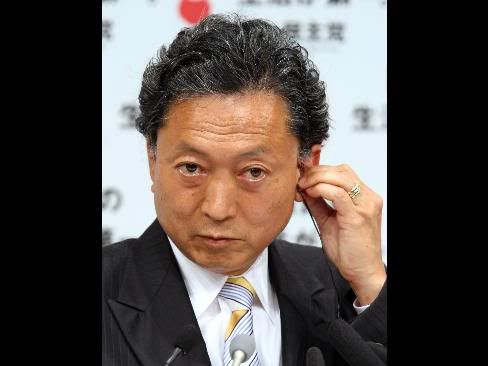
Hatoyama’s Win Pits Stanford PhD Against
Bureaucrats
By Stuart Biggs
Aug. 31 (Bloomberg) -- Yukio
Hatoyama, who ended 50 years of single-party rule
with vows to arrest Japan’s decay and tame its bureaucracy, is an
unlikely champion of change: His family and political roots run
deep in the party he defeated.
Hatoyama’s Democratic Party of Japan almost tripled its seats in
yesterday’s election, public broadcaster NHK projected, winning a
lower-house majority for the first time. The Liberal Democratic
Party, out of power for just 10 months since 1955, lost almost
two-thirds of its seats.
“We want to change the bureaucrat-led
politics” that has
existed in Japan for 140 years, Hatoyama told reporters
today. “I’m grateful for the courage the Japanese people have
shown.”
Hatoyama, who holds a Ph.D. in engineering from Stanford
University near Palo Alto, California, pledges to end the
government’s reliance on an unelected bureaucracy, which he says
hasn’t worked in the public interest. Pre-election polls showed
support for his plans to unify the fragmented pension system and
increase the number of doctors.
The DPJ is
a mix of former LDP lawmakers,
ex-socialists, one-time bureaucrats and trade unionists.
It is a “broad church” whose competing constituents have made
policy priorities difficult to identify, according to Jonathan Allum, a strategist
with KBC Financial Products in London.
No French Revolution
“This isn’t the French Revolution, these are not wide-eyed
radicals,” Allum said in an interview. “The leaders of the DPJ have
been around for a number of years and for a number of parties.
These are pretty mainstream people.”
Japan already has the world’s most rapidly aging society and the
largest public debt, projected to reach almost 200 percent of gross
domestic product next year. Unemployment rose to an all-time high
of 5.7 percent in July, household spending fell 2 percent and
consumer prices dropped a record 2.2 percent.
“I want a regime
change,” Minetaka Omura, a 24-year-old electrician,
said yesterday after voting for the DPJ in Tokyo.
“The economy is bad, and I
want the DPJ to stop spending tax money for public works and shift
it to welfare.”
Voters have given Hatoyama a mandate to switch priorities from
aiding the companies that built Japan’s $4.9 trillion economy to
helping families cope in a society where almost a quarter of the
population will be over 65 by 2014. To encourage people to have
children, the DPJ says it will increase child support and lower
education costs, paying for this by slashing outlays on roads,
bridges and public works.
People, Not Concrete
“The whole idea of people rather than concrete, and, ‘Let’s be
nicer to the Japanese population,’ could be immensely positive in
the long term,” said Philip
Whittome, who manages Japanese stocks at Investec
Asset Management in London. “The election might lead to some
changes in how Japan is run in ways that are underappreciated by
the foreign investment community.”
Not only is Hatoyama, 62, a former LDP lawmaker; his
grandfather founded the party and served as its first prime
minister, his father was foreign minister and his younger brother
served in the last administration.
Hatoyama left the LDP in
1993 to form a party in a coalition that briefly
took power. In 1998 he helped found the DPJ. He became the party’s
candidate for prime minister less than four months ago when
Ichiro
Ozawa, a fellow ex-LDP lawmaker, was forced to
resign as DPJ leader over a campaign finance scandal.
At Otsuka station in Tokyo, about 1,500 supporters turned out on
Aug. 25, shouting “Prime Minister Hatoyama” and cheering as he told
jokes about leaving the party his grandfather founded.
Restoring Ties
He laid out his opposition to red tape in a 1997 book “We Reject
Bureaucrats’ Leadership,” co-written with DPJ vice president,
Naoto
Kan. His speeches and essays also contain
references to promoting “fraternity,” referring to the need to
restore communities in Japan and improve ties within Asia.
The DPJ says its promises, which also include eliminating
highway tolls, will cost 16.8 trillion yen ($179 billion) in 2013.
The party has pledged not to raise the 5 percent consumption tax
and instead will stay within the existing budget by cutting
spending on public works, reducing the number of bureaucrats and
tapping the special accounts they manage.
Hatoyama “will bear the heavy responsibility of managing the
economy,” the Yomiuri, Japan’s largest daily newspaper, said in an
editorial.
The Nikkei-225 Stock Average
remains at a quarter of its 1989 peak and the LDP’s effort to spend
its way out of Japan’s ‘Lost Decade’ in the 1990s inflated
debt.
The LDP’s support plummeted, accelerated by the loss of hundreds
of thousands of public pension records at a time when the public
was becoming increasingly concerned about welfare and health care.
There have been more deaths than births in Japan’s population of
127 million in three out of the last four years.
Into the Ministries
To break up a system that allowed bureaucrats, corporations and
politicians to share power, the DPJ pledges to send 100 lawmakers
into government ministries. It also will ban retiring civil
servants from joining construction companies and other industries
they regulated, a practice known as “Descending from Heaven.”
“It may be difficult for the DPJ,” said Hiroyuki Kishi, a former trade
ministry civil servant and professor of economic policy at Tokyo’s
Keio University. “When you confront bureaucrats, knowledge and
information determine the battle.”
